As it becomes increasingly difficult to recruit people for the war, the system is turning more and more toward those who are easier to pressure. We have already written about how this works in the Penza region: debtors, people with legal problems, socially vulnerable people — anyone whose circumstances make it easier to place them before a choice that is hardly a choice at all.
But there is another particularly vulnerable source of manpower already inside the military system itself: young men fresh out of school who are performing compulsory military service.
They were sent to serve for one year. Their parents may have disagreed with what was happening in the country, but they relied on one simple assumption: compulsory military service is compulsory military service, while signing a contract to take part in a war is an entirely different decision.
It turned out that this boundary does not always exist.
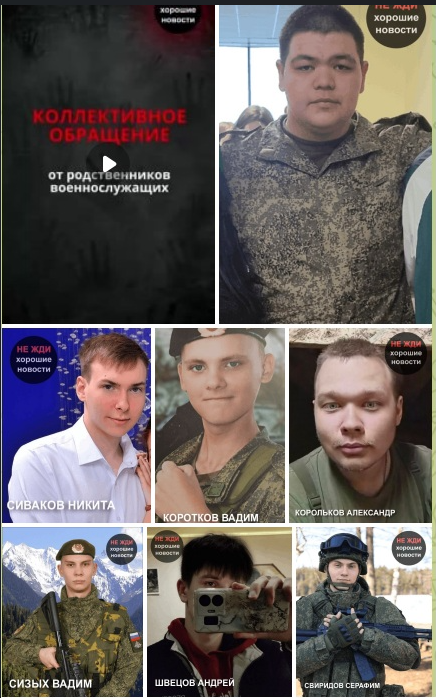
In September, relatives of conscripts recorded a collective video appeal. They allege that young servicemen are being forced to sign contracts through threats, psychological pressure, deception and, in some cases, physical violence.
Aisylu Baryeva, the mother of Ilvin Baryev, describes the methods briefly:
“Threats, intimidation, violence, deception.”
Natalya Radchenko, the mother of Nikita Sivakov, describes another form of pressure. According to her, her son was told:
“You’ll be killed anyway! But with a contract, you won’t die for nothing — your relatives will get money.”
That sentence perhaps contains almost the entire logic of what is happening.
The young man is no longer being asked whether he wants to fight. Instead, he is offered a choice over how exactly he will end up at war and how much money his family will receive if he dies.
Ekaterina Korotkova, the mother of Vadim Korotkov, born on 8 April 2007 and serving in the 186th Motor Rifle Territorial Control Regiment, describes not an isolated episode but what she says is a system:
“Hundreds of children were illegally forced to sign contracts. And sent to the SVO. Hundreds of lawsuits have been filed with military courts.”
These are the words of a relative, and it is for the courts to determine which of these contracts were in fact concluded in violation of the law. But the number of families simultaneously reporting similar circumstances already makes it difficult to reduce what is happening to one commander, one military unit or one conflict between a soldier and his superiors.
Then the next stage of the story begins.
First, parents try to prove that their son did not want to sign a contract.
Then they try to have it terminated.
Then they try to find out where he was sent.
And then some of them begin asking for something entirely different.
At least return the body.
Maria Korolkova had previously spoken about her son, Alexander Korolkov, and alleged that he too had been forced to sign a contract. Alexander has now been officially declared dead.
His mother says:
“For the second year, they have not returned the body to the family. I want my child brought home. We are asking them to return the dead home.”
The family has therefore gone through the entire chain: compulsory service, a contract, war, and notification of death. Yet even then the story did not end — the mother cannot receive her son’s body and bury him.
Polina Fedorova, the mother of David Fedorov, born on 18 November 2006, alleges that her son was forced to sign a contract even before beginning compulsory military service. He is now listed as missing.
Other mothers — Svetlana Sukhanova, Yaroslava Shvetsova and Elena Sviridova — are demanding that the circumstances under which such contracts were signed be investigated, that contracts concluded unlawfully be terminated, and that those responsible be held accountable.
They stress:
“We are not asking for special treatment. We are simply asking for every case to be investigated.”
And this is where the central question arises.
How did parents end up sending their sons into compulsory military service expecting, at the very least, that the state would follow its own rules — only to find themselves having to prove in court that their children had never intended to volunteer for war?
How did compulsory military service become, for some young men, a convenient point of access to a new source of manpower?
We have written this before: when human life inside a system begins to be measured in recruitment targets, contracts, payments and reports, the system gradually stops caring whom exactly it grinds up.
A debtor.
Someone in trouble.
Someone who can be frightened with the threat of a criminal case.
Or a young man fresh out of school who has already passed through the gates of a military unit.
The most frightening thing here is not even the pressure itself. It is the belief that there are guaranteed rules: that compulsory service will remain compulsory service, that a signature obtained without genuine consent can quickly be challenged, and that the machinery of the state will stop where the law ends.
Some parents discover that they trusted those rules for too long.
First, they demand that their son be returned from compulsory service.
Then they demand that the contract be cancelled.
Then they try to find the missing.
And then they ask for at least the body to be returned.
This is what can sometimes be found beneath all the external attributes of statehood — laws, courts, elections, uniforms and official speeches.
The knight’s armour remains in place.
But the face beneath it becomes visible only when a family is already asking for the body of its dead child to be returned.
Source: Telegram channel “Don’t Expect Good News”: https://t.me/ne_zhdi_novosti/7492