

Opinion Column
Oleg Elanchik
Member of the Sakharov Institute
Elena Kotenochkina
Member of the Sakharov Institute
Lev Ponomarev
Founder and President of the Sakharov Institute
Ahead of the opening of the United Nations General Assembly on September 8, members of the Sakharov Institute Oleg Elanchik, Elena Kotenochkina and Lev Ponomarev, in their column for Le Monde, call on the United Nations to find a way around Russia’s veto in the Security Council in order to compel Moscow to end its aggression against Ukraine.
Ahead of the 81st session of the United Nations General Assembly, which will take place from September 8 to 22, the international community must stop treating the paralysis of the Security Council as inevitable. The tools that would make it possible to move from declarations to action still exist. And international civil society must become involved in this process of transformation.
The full-scale war that Russia is waging against Ukraine is entering its fifth year. Its intensity continues to increase.
According to the United Nations Human Rights Monitoring Mission in Ukraine, in the first six months of 2026 alone, at least 1,396 civilians were killed in the country and another 7,978 were injured. Civilian casualties were 37% higher than during the same period in 2025. As of July 31, 2026, a total of 16,870 civilians had been killed in territory controlled by Ukraine.
Many experts believe that the actions of the Russian armed forces contain elements that may fall within the definition of genocide. Russian President Vladimir Putin openly denies the very existence of the Ukrainian nation. Representatives of the Russian authorities publicly threaten nuclear war.
Since 2014, the United Nations General Assembly has repeatedly condemned Russia and reaffirmed Ukraine’s sovereignty and independence. Most recently, on February 24, Resolution A/RES/ES-11/10 was adopted, once again reaffirming Ukraine’s territorial integrity and calling for an immediate, full and unconditional ceasefire between Russia and Ukraine. The resolution was supported by 107 states, with 12 voting against and 51 abstaining. It was therefore supported by a majority of the 193 UN member states.
However, the decisions adopted still lack effective mechanisms for implementation and oversight. General Assembly resolutions can acquire binding force only if approved by the Security Council. But in this case, the Council is unable to fulfil the responsibility entrusted to it: Russia, as a permanent member of the Council, has veto power while simultaneously being a party to the war.
This situation undermines the entire system of collective security: a state possessing veto power can use force against another state while at the same time blocking measures aimed at ending the aggression and protecting its victims.
The 81st session of the General Assembly must become a moment of transition from general declarations to real action for peace.
An Alternative Solution
Attempts to strengthen the United Nations have been made repeatedly. One of the most significant initiatives was proposed by France and Mexico in 2015: it provides for permanent members of the Security Council to voluntarily refrain from using the veto in situations involving mass atrocities.
At the 81st session, this initiative should be consolidated through a political resolution. As of May 2026, it was supported by 118 states. Its implementation would not require amendments to the Charter of the United Nations.
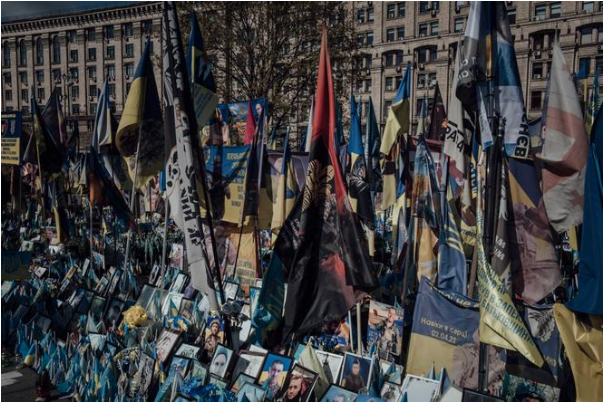
Maidan Memorial on Independence Square in Kyiv, April 19, 2026. Photo: Adrien Vautier / Le Pictorium for Le Monde.
An alternative or complementary solution could be the adoption by the General Assembly of a resolution calling for mandatory compliance with the requirement to abstain from voting set out in Article 27(3) of the UN Charter. Under this provision, when the Security Council takes decisions concerning the peaceful settlement of disputes, a Council member that is a party to such a dispute must abstain from voting.
The role of civil society and the human rights movement should not be underestimated. Civil society could unite around a common demand: to adopt a resolution on the voluntary renunciation of the veto and to ensure the unconditional application of the mechanisms provided for by the UN Charter when considering the war Russia is waging in Ukraine.
We can begin by sending appeals and petitions to the foreign ministries and parliaments of our countries, urging them to pay particular attention to the need to adopt such resolutions and to ensure that each state provides a public response to the proposals put forward.
The General Assembly should also be called upon to give the floor to victims of the war, prisoners of war, deported children and human rights defenders, and to establish public monitoring of the positions and voting records of different states.
During the 81st session of the General Assembly, peaceful rallies and pickets in support of these demands should also be organised outside United Nations Headquarters in New York. We can take inspiration from the climate movement: tens of thousands of people took to the streets and, in doing so, succeeded in making the climate issue one of the priorities on the UN agenda.
Every day, we must oppose the unpunished use of force, the rule of the strong, and the transformation of the Security Council into an instrument for protecting a state that violates the Charter of the United Nations.
Published in Le Monde on September 7, 2026.