

We have previously written about the astonishing sentences handed down by Russia’s judicial system, comparing punishments for brutal murders with those imposed for crimes that the authorities classify as politically motivated. Such comparisons help us understand whom Putin’s judicial system considers its real enemy, how it treats ruthless killers, and how it treats people who oppose the ideology of those in power.
Today we have another striking example. And this time, the story is so horrifying that we must warn readers: those with a sensitive disposition may want to skip this article. We invite everyone else to read it to the end, because it is not only about human cruelty, but also about the value that Russian “justice” places on human life.
So, Rostov-on-Don. A married couple: 33-year-old Yakov Mayboroda and his 23-year-old wife, Anastasia.
On April 28, 2023, they killed their own eight-month-old daughter. The court established that the parents strangled the child together, then dismembered her body, put some of her remains through an electric meat grinder, carefully packed them into plastic bags, and placed them in the freezer compartment of their household refrigerator.
Yes, you read that correctly. Through an electric meat grinder. Their own eight-month-old daughter.
There is no reliable evidence that the parents intended to eat the child’s remains. The court found that the couple had acted this way in an attempt to conceal evidence of their crime. But the very combination of a meat grinder, plastic bags, and a freezer inspires a horror that is difficult to put into words.
Forgive these details. But without them, it is impossible to understand the human tragedy we are talking about.
Her name was Lenochka. She was only eight months old.
Her nanny, Olga Shonova, remembered her as an exceptionally calm and cheerful child. She called Lenochka a true angel and said that in all her years of working with children, she had rarely met anyone like her. This was the little girl who, not long before, had been held in someone’s arms, fed, and gently put to sleep — and whose life was taken by her own parents.
She could not yet speak. She could not tell anyone what was happening in her family, complain about her parents, ask for help, or defend herself.
And here is what makes it particularly horrifying: the very people who were supposed to protect her from every danger became her killers.
But let us return to Russian justice.
On October 2, 2024, the Rostov Regional Court sentenced Yakov Mayboroda to 15 years in a maximum-security penal colony. His wife, Anastasia, received an even lighter sentence: 13 years in a general-regime penal colony.
Fifteen and thirteen years. Let that sink in.
For murdering their own eight-month-old child, acting together, subsequently dismembering her body, and attempting to conceal the crime.
Incidentally, the fact that the murder was committed by a group of people and that the victim was a young child were explicitly reflected in the legal classification of the crime. And the jury even found both parents deserving of leniency.
But that is not the end of the story.
After his conviction, the father apparently decided that serving his sentence was not necessary after all. He signed a contract with Russia’s Ministry of Defence and went to fight against Ukraine.
According to relatives, Yakov Mayboroda was killed at the front on April 3, 2025.
One might think the story ended there. But no. On September 25, 2026, a memorial to fallen soldiers was ceremonially unveiled in the village of Chertkovo, Rostov Region. The names of 93 servicemen who died during Russia’s invasion of Ukraine were engraved on granite slabs.
Among them was Yakov Mayboroda.
The very father who, together with his wife, strangled eight-month-old Lenochka and then took part in disposing of her remains.
His name is now permanently inscribed alongside those of other fallen servicemen. At the unveiling ceremony, those who had taken part in the current war were described as heroes who had given their lives for their Motherland.
And so a man who murdered his own child found himself among the officially honoured heroes.
But Mayboroda could have survived. And who knows? Perhaps, after returning from the front, he might even have visited Russian schools to take part in the “Conversations About Important Things” lessons, explaining to children the meaning of patriotism, honour, conscience, and love for the Motherland. He might have told schoolchildren how to become real heroes.
And then, perhaps, he might have strolled past playgrounds where children the same age as his daughter were playing — children fortunate enough to remain alive.
And exactly the opposite happens to the Kremlin’s ideological opponents who oppose the war. They face additional prison sentences while already behind bars. Sometimes for conversations with fellow inmates who, according to human rights defenders, deliberately steer prisoners towards dangerous topics and secretly record their words using concealed recording devices.
Take Dmitry Lyamin, for example. He was initially sentenced to eight years for attempting to set fire to a military recruitment office in Shuya. Then conversations with other prisoners became the basis for a new criminal case. On September 16, 2026, the court sentenced him to 17 years’ imprisonment in that case. Combined with his original conviction, his final prison term rose to 22 years. Another 14 years beyond his original sentence — in a new case arising from conversations held by a man who was already behind bars.
Such is ideological “justice”. A man convicted of murdering his own child can go to war, survive, return to freedom, and even
become an officially recognised hero. Opponents of the war may also have that option. But for them, it would mean betraying their own convictions — the very convictions that landed them behind bars.
And so we arrive at a horrifying paradox: a child murderer may regain his freedom for being willing to kill again, while an opponent of the war may face additional years in prison for refusing to betray his conscience.
But now let us turn to another story.
This time, we are not talking about the murder of a child, the dismemberment of a body, or an attempt to dispose of human remains. We are talking about a railway relay cabinet.
And about a man whom a Russian court deemed worthy of an even harsher punishment.
His name is Maksim Solovkin. He is an artist from Kolomna, near Moscow, who worked on digital drawings using a graphics tablet. At the time of his arrest, on July 20, 2024, Maksim was just 24 years old.
According to the human rights initiative Solidarity Zone, Maksim wanted to join the Freedom of Russia Legion, an armed formation fighting against Russian forces on Ukraine’s side.
He began corresponding with an unknown person online, who suggested that he prove the seriousness of his intentions by setting fire to a railway relay cabinet.
And Maksim agreed.
But this is where things get especially interesting.
According to human rights activists, hardly had the relay cabinet finished burning when officers of Russia’s Federal Security Service, the FSB, appeared seemingly out of nowhere and arrested the artist.
A remarkable coincidence, isn’t it?
This raises an obvious question: could this unknown online handler have been part of a sting operation orchestrated by Russia’s security services? After all, the FSB officers arrived with extraordinary timing.
There is no direct evidence of such a provocation so far. But the circumstances of the arrest provide ample reason to ask the question.
So, the young artist set fire to a relay cabinet. Such metal structures may cost around 100,000 rubles, although the precise amount of damage in Solovkin’s case has not been established in the publicly available materials.
We have no intention of justifying arson attacks on railway infrastructure. Such actions can be dangerous, and criminal liability exists for them.
But another question arises: what punishment did the Russian judicial system impose for this act?
On October 2, 2026, Maksim Solovkin was sentenced to 19 years’ imprisonment under a terrorism-related provision of the Criminal Code.
He is to spend the first five years in prison and the remaining fourteen in a maximum-security penal colony.
Nineteen years.
For setting fire to a railway relay cabinet.
According to published information, no one was killed as a result of the arson.
Now let us compare those figures once again.
15 years for murdering an eight-month-old daughter, dismembering her body, and destroying her remains with a meat grinder.
13 years for the second participant in the same crime, the murdered girl’s mother.
19 years for an artist who set fire to a railway relay cabinet.
And while the first convicted man, after going off to war, earned himself a place on a memorial to “heroes”, the second must spend almost two decades behind bars.
Of course, from a legal standpoint, these are different criminal offences. But that is precisely why the question must be directed not only at individual judges but at the entire system of criminal punishment that makes such a disparity in sentences possible.
Try to imagine the expressions on this couple’s faces if they had known in advance that murdering their own eight-month-old Lenochka would bring them shorter sentences than those imposed on a 24-year-old artist for setting fire to a metal cabinet.
And even that is not the height of the absurdity: one of them would eventually be given a chance to leave prison by going to war, only to have his name engraved on a memorial to heroes.
In other words, a man convicted of murdering his own child can become worthy of official commemoration, while a young artist who committed a dangerous and perhaps deeply ill-considered act of resistance receives 19 years in prison.
Such is the arithmetic.
I do not want to grind through the details of this story any further. There is too much human horror in it, and the fate of little Lenochka, who lived for only eight months, is too terrible.
And yet it is impossible to shake a horrifying thought: perhaps the most terrible part of this story does not end with the child’s death. It continues in a society where the murderer of his own daughter ends up on a memorial to heroes, while a man who set fire to a railway relay cabinet receives a far longer prison sentence than the killers of this innocent little girl.
And one cannot help thinking of Lenochka — that same calm, cheerful little girl whom her nanny called an angel.
She will never know what kind of country she would have grown up in. She will never see the man convicted of her murder proclaimed a hero. She will never hear lectures about the importance of loving one’s Motherland from people for whom their own child was not even worthy of the right to live.
And that, perhaps, is the most terrible thing one can say about a state in which such a story became possible.
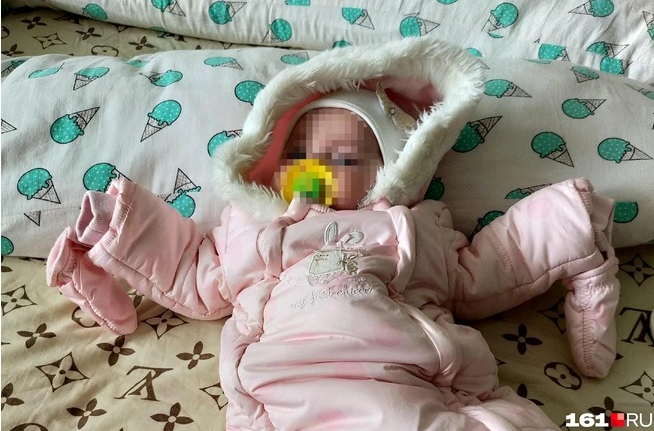
Photograph of little Lena. Source: 161.RU
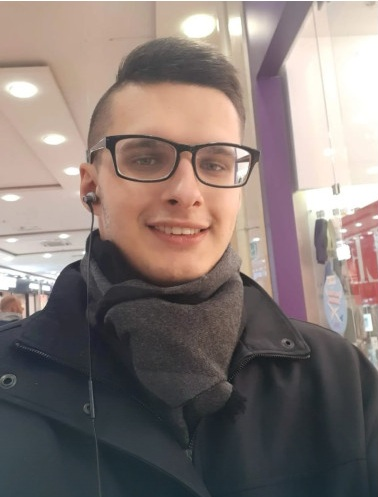
.Photograph of Maksim Solovkin — artist, “terrorist” and “saboteur.” Source: Memorial.
Source: The Insider — https://theins.ru/news/298064
Source: Political Prisoners Support. Memorial — https://memopzk.org/news/hudozhnika-iz-kolomny-prigovorili-k-19-godam-po-delu-o-podzhoge-relejnogo-shkafa/
Source: Andrey Sakharov Institute, article by Denis Grigorian, “Dmitry Lyamin was sentenced to 22 years for a scorched window frame and conversations with fellow inmates” — Read article
Source: Telegram channel “Politzek-Info” — https://t.me/politzekinfo/9945