

Another tragedy in the so-called legal system of modern Russia. This time, in occupied Crimea. And it began not with a criminal case, but with Russia’s invasion in 2014, when the occupation of Ukrainian territory tore thousands of families apart.
One of those families was that of Viktoria Strilets. Her husband, a Ukrainian serviceman, moved to Mykolaiv with his military unit. Viktoria remained in Crimea. She was later diagnosed with multiple sclerosis, a serious disease of the nervous system requiring regular treatment.
Her daughter Aleksandra, who had been living with her father in Ukrainian-controlled territory, returned to occupied Crimea to care for her mother. For her sake, the young woman gave up university, further education and her own plans for the future. Instead of studying, she had to work several jobs, pay for medication and support her family.
What more could possibly be taken from someone who had already sacrificed her future to care for her sick mother?
As it turned out, almost everything.
According to published reports, individuals described as handlers contacted the women through Telegram and offered them money in exchange for photographs of Russian military facilities. The family needed money, including for Viktoria’s medical treatment. The women agreed. The photographs were taken and sent to Aleksandra.
But according to Viktoria, at the last moment they became frightened and decided not to go through with the plan. The women maintain that the photographs were never sent to their intended recipient.
And what happened next?
Searches, interrogations, arrests and charges of high treason.
But if the photographs were never sent, how did the FSB learn about their existence and the women’s intentions?
Who was on the other end of the Telegram conversation? Who offered the money? And why did the information end up in the hands of Russian security services?
There have been cases in which Russian security agencies provoked people into taking certain actions and then used those actions as grounds for criminal prosecution. This raises an obvious question: were these so-called handlers connected to the FSB from the very beginning? Were they the ones who offered the money, encouraged the women to take the photographs and then informed the security services?
This is a hypothesis, not an established fact. But the public has no way to investigate it: the trial was held behind closed doors, the evidence of the alleged transfer of information to Ukrainian intelligence has not been made public, and the identities of the handlers remain unknown.
Russian investigators claim that the photographs were transmitted to the Ukrainian side. The women say they changed their minds. There is no independent way to verify these conflicting accounts.
On August 5, 2025, Danil Zemlyukov, a judge of the Sevastopol City Court, sentenced both Viktoria and Aleksandra Strilets to 12 years in a penal colony.
Twelve years for a seriously ill mother. Twelve years for the daughter who returned to Crimea to care for her.
But Russian justice did not stop there.
Viktoria, who suffers from multiple sclerosis, requires regular treatment — every six months, according to her own account. Without appropriate therapy, the disease can progress, causing severe neurological damage.
Now the sick mother is imprisoned in one penal colony, while the daughter who once cared for her is held in another, thousands of kilometres away.
Is Viktoria receiving the medication she needs? Is she undergoing her prescribed treatment? What will happen to her after several years in prison?
There are no public answers.
But there is another circumstance that makes this story particularly horrifying.
During the criminal proceedings, Aleksandra became pregnant. On March 14, 2025, at just 27 weeks of pregnancy, she gave birth to a daughter, Valeria.
The newborn weighed only 530 grams.
The baby was born with extremely serious complications. She could not breathe on her own, remained in intensive care, underwent operations and depended on life-support equipment.
Doctors fought to keep her alive. Aleksandra stayed by her side whenever circumstances allowed.
Then came the day of sentencing.
At that point, little Lera was not even five months old. She remained in hospital in an extremely serious condition.
Aleksandra asked the court to defer her prison sentence so that she could care for her daughter. Doctors confirmed in writing that the mother’s constant presence was necessary.
Furthermore, Article 82 of the Russian Criminal Code provides for the possibility of deferring imprisonment for women with children under the age of 14. Even a charge of high treason did not, in itself, exclude that possibility.
Do you think this stopped the judge?
No. Danil Zemlyukov refused to grant the mother a deferral.
According to Aleksandra, the court justified its decision by pointing out that the children had a father.
There is a father, so the mother can be sent to prison. Even when her child has been hovering between life and death since birth.
We believe it is necessary to preserve the name and photograph of this judge. History should remember not only the victims, but also those who made the decisions that determined their fate. Let the children and grandchildren of these officials one day read what their relatives did in the name of the Russian state.
Aleksandra still hoped that her appeal would change the outcome.
On January 21, 2026, Elena Udod, a judge of the Third Court of Appeal of General Jurisdiction, upheld the sentence. Once again, no deferral was granted.
Aleksandra was subsequently transferred to a penal colony in Chuvashia, approximately 2,200 kilometres from home.
Meanwhile, little Lera continued fighting for her life.
Her father, Maksim, was left alone to care for two children. He learned how to operate medical equipment, spent practically all his time at the hospital and prepared a room at home with a ventilator, an oxygen concentrator and a vital-signs monitor.
He was preparing to bring his daughter home.
On September 10, 2026, Lera left the hospital for the first time in almost a year and a half.
At home, her father, older sister, own room and toys were waiting for her.
Only her mother was missing.
She was in a penal colony thousands of kilometres away.
The following morning, September 11, at approximately 5:30 a.m., Lera died.
The little girl, born weighing just 530 grams, had fought for every breath for almost a year and a half. Her survival had depended on doctors, surgery and medical equipment.
We cannot claim that her mother’s presence would certainly have saved her. The severity of her condition makes such a conclusion impossible without an independent medical assessment.
But we do know that doctors insisted on the mother’s presence, the law allowed the court to grant a deferral, and the judges refused twice.
Behind those decisions lie the fates of three generations of women.
Viktoria — a seriously ill woman with multiple sclerosis, serving a 12-year sentence. Whether she is receiving necessary treatment remains unknown.
Aleksandra — a young mother who gave up her education to care for Viktoria. Now she faces years of imprisonment and must live with the knowledge that her own daughter has died.
Valeria — a little girl born weighing just over half a kilogram, who died without ever seeing her mother return.
Three generations. Two penal colonies. Twenty-four years of prison sentences. And a child who is no longer alive.
All of it resulting from decisions made by Russian courts.
But another question remains: what awaits Viktoria and Aleksandra now?
On November 1, 2026, Russia ceased to be a party to the European Convention for the Prevention of Torture, withdrawing from one of the international mechanisms for monitoring places of detention.
Torture is prohibited under Russian law and remains prohibited. But has that prohibition always prevented torture in Russian prisons, penal colonies and pre-trial detention centres, including cases involving the participation or acquiescence of state officials?
Now another mechanism of independent monitoring has disappeared.
What happens next? Will the authorities weaken the remaining safeguards? Or will they simply make sure that information about torture disappears from public view altogether?
Because if nobody finds out about the torture, then as far as the state is concerned, it is as though it never happened. There will be no witnesses, no public outrage, no uncomfortable questions. But the torture itself will not disappear.
In the Strilets case, we see the same principle of secrecy: the public cannot examine the evidence supporting the charges, and the family cannot obtain a publicly verifiable answer about the medical care provided to the imprisoned mother.
If nobody can see the evidence, hear the defence’s arguments or scrutinise the court’s decisions, what becomes of the presumption of innocence?
Under such circumstances, a closed hearing is enough to deliver a sentence, and people willing to obey orders are enough to carry it out.
And this is the outcome of the story.
First, their homeland was taken from them when Crimea was occupied and their family was torn apart. Then the daughter was deprived of the opportunity to care for her sick mother. Next, the mother was denied the opportunity to care for her own critically ill daughter. And then the child died.
But the tragedy is not over.
Only God knows how Viktoria and Aleksandra will endure the remaining years of imprisonment. One needs regular medical treatment; the other must live with the death of her child behind prison walls.
We have already examined how the Russian judicial system operates and how its representatives enrich themselves through it in our previous article — “12.5 Years in Prison for a Gravely Ill Pensioner for Loving Her Homeland and Donating €13. Galina Bekhter Is on the Brink of Life and Death in a Russian Prison”.
What humanity can be expected from a justice system in which loyalty to those in power takes precedence over human life?
The judges did not even need to overturn Aleksandra’s conviction to allow her to remain with her sick daughter. They merely had to exercise an option provided for by law.
But they chose not to.
Responsibility for maintaining a politically dependent judicial system rests, in part, with Vladimir Putin, under whose rule it has taken its present form.
And most frightening of all, we do not know how many more lives will be destroyed before this vicious cycle can finally be broken.
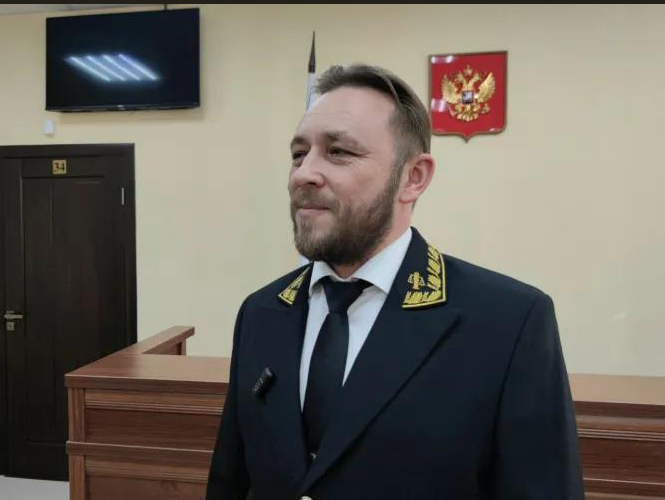
Danil Zemlyukov, a judge of the Sevastopol City Court, who sentenced Aleksandra and Viktoria Strilets to 12 years in a penal colony each and refused to grant Aleksandra a deferral to care for her critically ill daughter.
Source: Social media / Novaya Gazeta.
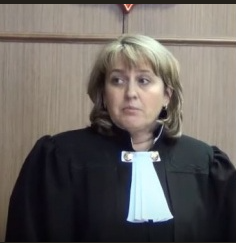
Elena Udod, a judge of Russia’s Third Court of Appeal of General Jurisdiction, who upheld the 12-year prison sentences imposed on Aleksandra and Viktoria Strilets.
Source: Social media / Novaya Gazeta.
The People Behind the Verdict
Before the criminal case, Aleksandra lived the ordinary life of a young woman. She worked as a waitress, a sales assistant in a building-supply store and in a butcher’s shop. It was there that she met Maksim, the future father of her children.
In 2020, their first daughter, Solomiya, was born. The delivery was so difficult that both mother and child nearly died. The baby weighed just over a kilogram. Aleksandra suffered serious complications, but both survived, and Solomiya was successfully nursed to health.
Aleksandra later joked that she was destined to give birth to “Thumbelinas.” Back then, she could not imagine that her second daughter would be born even smaller, and that the struggle for her life would unfold against the backdrop of criminal prosecution.
When Lera was born, she measured just 30 centimetres and weighed 530 grams. Doctors allowed Aleksandra to visit her daughter only for short periods.
During one of the first visits, the newborn girl grasped her mother’s finger. Aleksandra wrote about it on social media. That little gesture later became their personal ritual.
When, several weeks later, Aleksandra was finally allowed to hold her daughter, she could hardly put her feelings into words. The little girl calmed down in her arms, and for the first time, her mother could do more than look at her through medical equipment — she could actually hold her.
On the day of sentencing, Aleksandra was counting on a deferral of her prison term. She hoped that her mother would receive a suspended sentence. Meanwhile, Lera was due to undergo another operation.
Instead, Aleksandra heard that she would spend the next 12 years in a penal colony.
According to her recollections, Viktoria burst into tears immediately. Aleksandra herself could not even cry at first. The tears came only after she was taken to the pre-trial detention centre.
Meanwhile, Maksim was left alone with two children.
His youngest daughter remained in intensive care. Her condition would improve, then become critical again. Sometimes she began breathing on her own, only for doctors to have to reconnect her to the machines.
Once, things became so serious that Aleksandra had already said goodbye to her daughter in her thoughts. But several hours later, the little girl began breathing again.
Maksim learned how to operate complex medical equipment, searched for medication and special nutritional supplies, and spent almost all his time at the hospital. He prepared the home for his daughter’s return, installed the necessary equipment and even planned to buy a backup power supply in case of an electricity outage.
At the same time, he was trying to bring Aleksandra home. He appealed to the human rights commissioner, wrote to Vladimir Putin and hoped for a pardon or a prisoner exchange.
According to journalists, he never received a reply.
But Maksim did not give up hope.
On September 10, 2026, Lera was finally discharged from hospital.
That day, Maksim wrote to journalists that he believed life would gradually get better, Aleksandra would be released and the family would be reunited.
“And we will all be together and happy again.”
At home, Lera was awaited by her father, her older sister Solomiya, her own room and her toys.
For the first time in almost a year and a half, the little girl was going to spend the night not in a hospital ward, but in her own home.
Only her mother was missing.
She was in a penal colony thousands of kilometres away.
The following morning, September 11, at around 5:30 a.m., Lera was gone.
Maksim told a journalist about her death in a voice message. He was crying.
The little girl, whose life they had fought to save for almost a year and a half, spent just one night at home.
And neither her mother nor her grandmother was able to return.
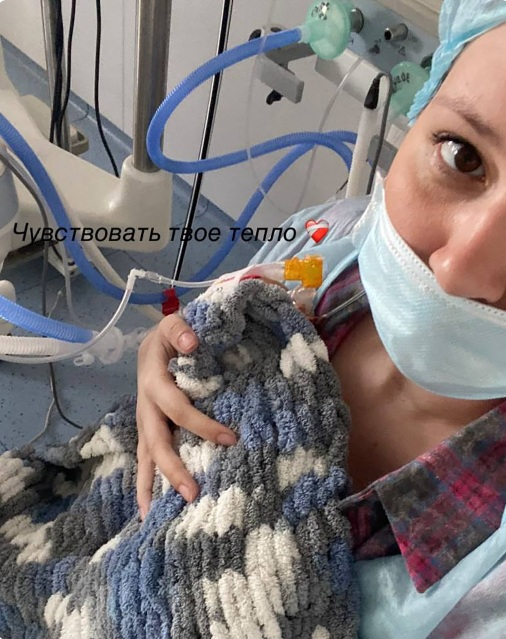
Aleksandra Strilets avec sa fille nouveau-née Lera, qui ne pesait que 530 grammes à la naissance.
Source : archives personnelles d’Aleksandra Strilets / Novaïa Gazeta Europe.
Sources
Source: Novaya Gazeta Europe — “Не убийцы, не злобные монстры” (“Not Killers, Not Evil Monsters”), https://novayagazeta.eu/articles/2026/09/14/ne-ubiitsy-ne-zlobnye-monstry
Source: Mediazona — investigation into the Strilets family, https://zona.media/article/2026/01/14/strilets
Source: Novaya Gazeta — “Дюймовочку убили” (“Thumbelina Was Killed”), https://novayagazeta.ru/articles/2026/09/11/diuimovochku-ubili
Source: Novaya Gazeta — “Нечем дышать” (“Unable to Breathe”), https://novayagazeta.ru/articles/2026/01/22/nechem-dyshat
Source: Political Prisoners Support — Memorial, Viktoria Strilets, https://memopzk.org/figurant/strilecz-viktoriya/
Source: OVD-Info — Russia’s withdrawal from the European Convention for the Prevention of Torture, https://ovd.info/express-news/2026/11/03/rossiya-vyshla-iz-evropeyskoy-konvencii-po-preduprezhdeniyu-pytok-chto-eto