

We would like to tell you another horrifying story about what the so-called Russian authorities are doing to people living in the occupied territories of Ukraine.
First, Russian forces seized part of the Zaporizhzhia region, along with the people who could not or did not want to leave their homes and move to Ukrainian-controlled territory. Then came a kind of population filtration: separating those who supported Russia from those who continued to regard Ukraine as their homeland.
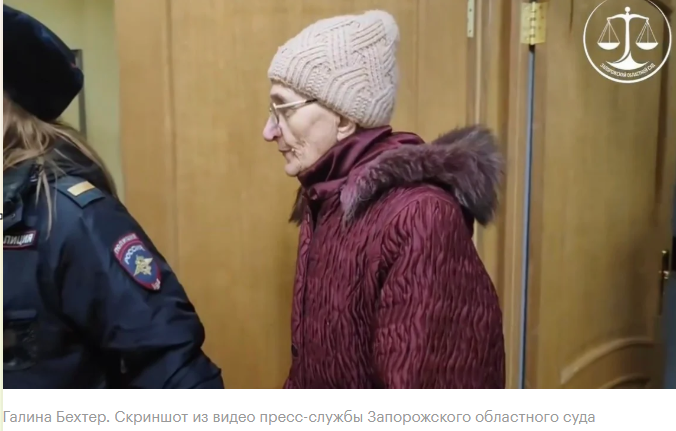
And here is one such story. The story of 68-year-old Galina Bekhter, an ordinary Ukrainian pensioner who lived with her husband in their own home in the Zaporizhzhia region.
The couple made no secret of their pro-Ukrainian views. Russian soldiers had already taken them away for questioning because of those views. Later, Galina was detained and transferred through detention facilities in Melitopol, Yakymivka, Donetsk and Simferopol. Her husband, who remained in their home village, died in January 2026. Perhaps death spared him from having to witness everything that subsequently happened to his wife.
The Russian authorities accused Galina Bekhter of high treason. For transferring approximately €13 to support the Armed Forces of Ukraine.
Yes, you read that correctly. Thirteen euros.
On March 5, 2026, the so-called Zaporizhzhia Regional Court sentenced the pensioner to 11 years in prison.
But that was not enough for the prosecutor. He considered the sentence too lenient and demanded that it be increased to 16 years.
We have already written about the offences for which women receive comparable prison sentences in Russia. Let us recall the case of Anastasia Mayboroda, who, together with her husband, was convicted of murdering their own eight-month-old daughter, little Lenochka. The child’s body was dismembered, and some of her remains were put through a meat grinder. Anastasia Mayboroda received 13 years in prison for this crime.
Now let us compare.
For murdering and dismembering their own eight-month-old child — 13 years.
For transferring €13 in support of her homeland — the prosecutor demands 16 years.
In other words, a woman received a shorter sentence for murdering an infant than the Russian prosecutor demanded for a Ukrainian pensioner who had made a financial donation.
But even that is not the most astonishing part.
Before accusing Galina Bekhter of high treason, the Russian authorities had themselves arrived on her land, redrawn state borders and effectively declared: you now have a different homeland. And this is the homeland you are required to love.
If you continue to love the country in which you were born and have lived your entire life, you will be imprisoned alongside the most ruthless murderers.
And that is exactly what happened.
Unfortunately, the story does not end there.
While in detention, Galina Bekhter’s health began to deteriorate rapidly. We cannot say for certain what illness caused her condition. But the accounts of those who were with her are horrifying.
At first, she began eating poorly. Then she almost entirely lost the ability to eat on her own. She started losing her memory, stopped recognising people and became unable to take care of even her most basic personal hygiene. Sometimes she would walk into the shower fully dressed and come out wearing the same clothes.
Her mental and physical condition deteriorated so rapidly that her cellmates suspected progressive dementia.
At a height of 176 centimetres, she weighed approximately 50 kilograms. According to fellow prisoners, she spent nearly all her time lying down, could no longer change her clothes independently and had lost control of her bodily functions.
Imagine someone who can no longer eat, wash or even use the toilet without assistance.
And who came to her aid?
The medical service? Perhaps the prison administration, which is responsible for the life and health of a person under its control?
No. The people providing Galina with daily care were other prisoners, including elderly women who had likewise been accused of high treason by the Russian authorities.
They fed her with a spoon, crushed her food and medication, washed her, changed her clothes and laundered her soiled belongings. They literally had to coax her to the table and keep her there so that she would eat at least a little.
One political prisoner in particular, Larisa Belyaeva, did an extraordinary amount for Galina, caring for her for approximately six months.
Now consider what happened next.
Despite the pensioner’s extremely serious condition, she was sent on a prisoner transfer to a penal colony. The journey lasted more than three weeks.
Larisa Belyaeva was on the same transfer. She understood perfectly well that Galina was virtually incapable of looking after herself and required constant care.
But when the women arrived at a transit penal colony in the Samara region, they were placed in separate cells.
Larisa tried to explain to the prison staff that Galina could not be left without assistance. She insisted that the woman was unable to eat or care for herself independently.
No one listened.
And here a remarkable paradox emerged. Contrary to the common perception of the brutality of prison life, the prisoners proved far kinder and more humane than those who officially represent the law and are regarded as law-abiding citizens. Those whom the state had branded criminals were trying to save a helpless woman’s life, feeding her, washing her and caring for her. Meanwhile, the prison staff, whose duty was to ensure her safety and health, made a decision that deprived her of the person who had effectively kept her alive for six months. A contrast that hardly needs further explanation.
It would be inaccurate to say that Galina received no medical assistance whatsoever: there were reports of intravenous drips and medication. But according to her cellmates, her condition continued to deteriorate, and there is no confirmation that she received comprehensive treatment capable of stopping that decline.
Repeated attempts were made to secure medical examinations, proper care and a decision about hospitalisation. Larisa Belyaeva even appealed to the Russian human rights ombudsman, describing Galina’s condition.
According to Belyaeva, no response followed.
And there is another circumstance that deserves particular attention.
By May 28, 2026, both Galina Bekhter’s rapidly deteriorating health and the Russian prosecutor’s demand to increase her sentence to 16 years were already public knowledge.
On July 6, the appellate court did indeed increase her sentence — to 12 years and 6 months.
Just six months less than Anastasia Mayboroda received for murdering and dismembering her own eight-month-old daughter, some of whose remains, according to the investigation, were put through a meat grinder.
Compare the figures once again: 13 years for murdering one’s own child, and 12 and a half years for transferring €13 to support one’s homeland. And the prosecutor had demanded the full 16 years for a 68-year-old pensioner.
All this despite the fact that human rights defenders had already been reporting on Galina’s grave condition by the time her appeal was heard.
Yet the judicial machinery continued to operate. Not towards saving a human life, but towards increasing a prison sentence.
Let us return to Galina Bekhter.
First, her homeland was taken from her, with its territory declared Russian. Then her freedom. Then she lost her husband. And now, according to her cellmates, she is rapidly losing her health as well. Watching how she is being “helped” to cope with her severe mental and physical deterioration, a terrible suspicion inevitably arises: is this system now prepared to take the last thing she has left — her life itself?
But behind everything that has happened stand very real people, including judges who make decisions about prisoners’ lives.
Journalists from The Insider identified the judge involved in increasing Galina Bekhter’s sentence: Alexander Vladimirovich Besedin, a judge of Russia’s First Court of Appeal of General Jurisdiction.
Unfortunately, we have so far been unable to find reliably identified photographs of this judge or of the prosecutor who demanded 16 years for a gravely ill pensioner. We would like the public to know the people who make such decisions.
And here we will venture a harsh judgment: an independent and incorruptible judge in Russia’s current system of political justice seems to us an almost impossible phenomenon. It is difficult to speak of judicial independence or fidelity to one’s conscience when judges agree to carry out decisions that turn justice into an instrument for intimidating the population, including residents of occupied Ukrainian territories and elderly, gravely ill people.
And forgive the comparison, but a judge who refuses to compromise his conscience to meet the demands of those in power seems almost as improbable as a genie who, having gained his freedom, voluntarily dreams of returning to the lamp and remaining its slave forever.
But there is another side to Russian justice — corruption among judges. The problem lies not only in individual dishonesty but in a system built on judges’ dependence on those in power. Here, independence and integrity become threats to one’s career, while loyalty and readiness to follow orders become guarantees of personal well-being.
As the saying goes, who has a good life in Russia?
Quite recently, Novaya Gazeta reported on the continuing confiscation of assets belonging to Alexander Chernov, the former chairman of the Krasnodar Regional Court, and people associated with him. Under a 2025 court ruling, assets worth approximately €142 million had already been transferred to the state. Subsequently, further property worth approximately €9.8 million was confiscated, including 36 kilograms of gold.
In total, almost €152 million in identified assets! And that is only what has been uncovered and officially disclosed. How much more might remain undiscovered, unaccounted for or unreported is anyone’s guess.
Nor is this the only corruption scandal involving Russian judges.
Of course, we are not claiming that the judge who heard Galina Bekhter’s case has any connection with the wealth of Chernov’s family. These are entirely separate cases. But such stories demonstrate how a profession supposedly dedicated to defending the law and justice can become a source of almost inexhaustible personal enrichment.
Perhaps we are comparing things that cannot be compared. But we wanted to show how generously this system can reward a kind of indulgence granted to those who live by the state’s unwritten “rules” — and what becomes of honour, conscience and human life in the process.
And against the backdrop of all these multimillion-euro fortunes, court decisions and declarations about legality, there remains one elderly Ukrainian woman who, according to her cellmates, has virtually lost the ability to understand what is happening around her or to care for herself.
What will happen to Galina Bekhter now?
Who will feed her? Who will wash her? Who will ensure that she receives treatment? And who will answer for it if she does not survive her imprisonment?
Or will we soon have to publish yet another obituary for a political prisoner who has died in custody? We have already published far too many of them.
Sources:
Mediazona — Galina Bekhter’s persecution, deteriorating health and prison transfer
Novaya Gazeta Europe — “Please Send Adult Diapers”: Testimonies from Galina Bekhter’s Cellmates
The Insider — A 68-Year-Old Ukrainian Woman with Suspected Progressive Dementia Has Her Prison Sentence Increased
Novaya Gazeta — “Greetings from Pandora”: Confiscation of the Former Krasnodar Regional Court Chairman’s Assets Continues
Andrei Sakharov Institute — Real-Life Horror: The Murder of an Eight-Month-Old Daughter and a Railway Relay Cabinet Case